
Every slot review quotes an RTP figure, but what does RTP actually mean once you get past the percentage sign? Return to Player is a real, testable number — but it’s also the most misunderstood spec on a paytable, wrongly read as a per-session promise when it’s really a long-run average measured over millions of spins. This guide walks through what RTP mathematically is, how it’s actually tested, why your own session can look nothing like the published figure, and how it interacts with volatility — using real, verified figures from games we’ve already reviewed rather than invented examples.
Where to Play UK-Licensed Slots
What RTP actually is
RTP (Return to Player) is the percentage of every pound staked on a slot that the game is mathematically designed to pay back to players, calculated over its full theoretical lifetime — not one spin, one session or even one player, but every spin the game will ever produce, taken together. A slot published at 96% RTP is built so that, across that entire body of play, £96 comes back for every £100 staked, with the remaining £4 (the house edge) retained by the operator. It’s a design target baked into the game’s math model before the game is ever released, not a running total that adjusts to how you personally play.
How RTP is calculated and tested
RTP isn’t a marketing figure the studio invents — it’s derived directly from the game’s paytable and reel math, then verified by independent testing houses before the game can be certified for a regulated market. Testers run enormous simulated spin counts against the declared math model to confirm the actual output lands within an accepted tolerance of the published figure, and UK-licensed operators are separately expected to monitor real-money RTP in play against the advertised number, flagging both under- and over-payment. That independent testing step is exactly why RTP is treated as a trustworthy spec rather than a claim — it’s checked by someone other than the studio that built the game.
Theoretical RTP vs a single session
The gap that trips most players up: RTP describes millions of spins, and a session is a few hundred at most. Over a short session, variance dominates completely — you can lose your whole balance on a 98% RTP game, or double it on a 92% one, and neither outcome tells you anything about whether the published figure is accurate. The percentage only becomes visible as a pattern once you zoom out to a sample size far larger than any individual player will ever personally generate. Thinking of RTP as “what I'll get back tonight” is the single most common misreading of the number.
Common RTP misconceptions
The most persistent myth is a direct restatement of the session problem above: a 96% RTP does not mean you personally get back £96 of every £100 you stake. You might get back nothing, or you might get back ten times your stake — the 96% is a statement about the game's total long-run output, not a per-player refund schedule. A few other misconceptions worth clearing up:
- “A slot is due a win.” Every spin is independent of the last (see RNG, below), so a long losing run has no bearing on the next spin’s odds.
- “Higher RTP means bigger wins.” RTP says nothing about win size or frequency on its own — that's what volatility describes, and two games with the same RTP can pay in completely different shapes.
- “The RTP I read online is definitely what I'm playing.” Not always true — see the configurable-versions point below. The only figure that's guaranteed accurate for your session is the one shown in that specific game's own paytable, on that specific casino.
RTP and volatility together
RTP and volatility answer different questions — how much comes back, versus how it arrives — and reading them together is what actually predicts how a game will feel to play. Some real, verified pairings from games we've reviewed in full show the range:
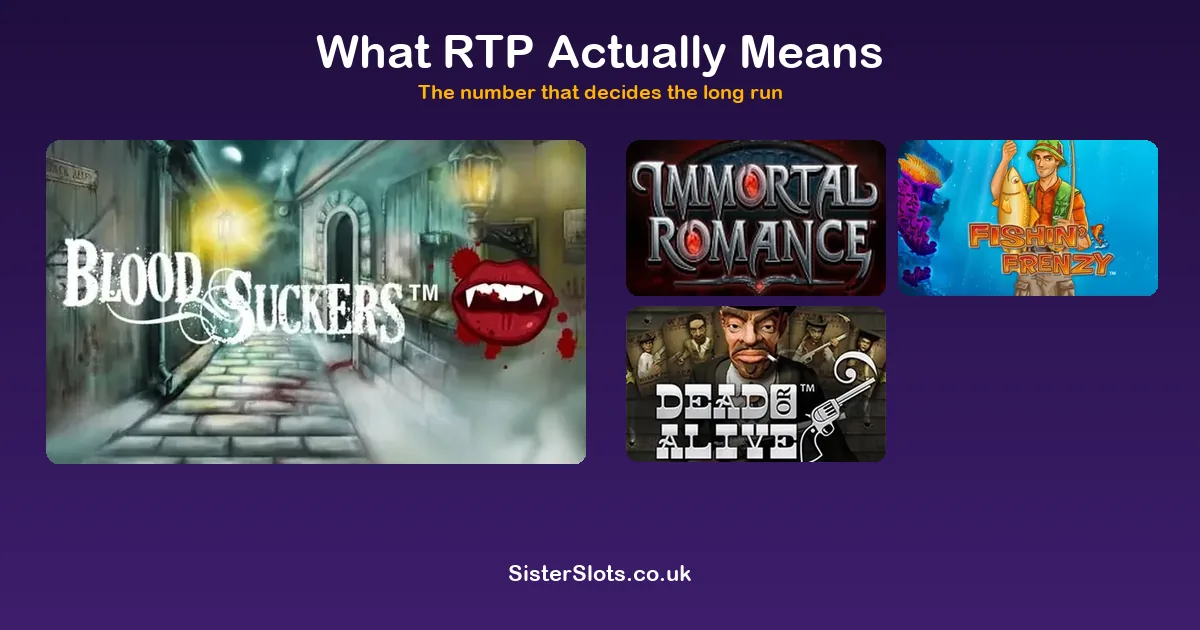
- Blood Suckers publishes at 98.00% RTP with Low volatility and a 45% hit frequency in its default configuration — one of the highest published RTPs in mainstream slots, delivered as frequent, modest wins rather than rare big ones.
- Dead or Alive publishes at 96.80% RTP but runs famously high, "brutal" volatility — a lower headline RTP than Blood Suckers, paid out as long dry spells broken by much bigger hits. Both figures are entirely legitimate; they're just different bets.
- Immortal Romance sits at 96.86% RTP, paired with the Wild Desire feature and a 12,150x ceiling — a mid-to-high RTP wrapped around genuinely high-volatility bonus rounds.
- Fishin' Frenzy publishes at 96.12% RTP with medium volatility, while its own sequel Fortune Spins trades roughly a full percentage point of that RTP for a much bigger max win and a volatility rating that climbs to High — a single franchise demonstrating the RTP-for-volatility trade-off in one place.
None of these figures make one game "better" than another in the abstract — a high-RTP, low-volatility game and a lower-RTP, high-volatility game can both be entirely fair products; they simply spend the same underlying percentage differently across a session.
Where to actually find a game's real RTP
The only figure worth trusting is the one inside the game itself — open the paytable or game-info screen (usually an "i" icon) and the RTP is listed there, specific to the build you're actually playing. This matters because it's genuinely worth flagging honestly: some games ship in multiple RTP configurations, and the operator, not the player, chooses which one goes live on a given casino. Blood Suckers is a public example of this — published at 98.00% by default, but built to ship in up to six operator-configurable payout versions running from roughly 90% upward. A figure quoted by a review site (including this one) is the studio's default or most commonly deployed configuration; the in-game paytable on your specific casino is the only source that's guaranteed accurate for the session you're about to play.
RTP FAQs
Is a higher RTP always better?
Not on its own. RTP tells you the long-run percentage returned, but volatility tells you how that return is shaped — a 96% RTP low-volatility game and a 94% RTP high-volatility game can both be perfectly fair, they just deliver the maths in very different session shapes. Pick on volatility as much as on the headline RTP number.
Does RTP change per casino?
It can. Some games ship in several operator-configurable payout versions with different RTPs, and the casino — not the player — chooses which one goes live. Blood Suckers is a public example: it's published at 98.00% by default but ships in up to six configurable versions running as low as roughly 90%. Always check the in-game paytable for the exact figure your casino is running, not just what a review site quotes.
What counts as a good RTP for a slot?
As a general rule of thumb, most mainstream UK slots sit in the mid-to-high 90s percent, and anything in that range is considered solidly competitive by industry convention — there's no official regulatory minimum RTP in Great Britain. Treat any specific percentage as a guide, not a guarantee, and always confirm it on the game's own paytable.
Is RTP the same as my chance of winning?
No — that's hit frequency. RTP is the percentage of total stakes returned over the long run; hit frequency is how often any individual spin lands a win at all. A game can have a strong RTP built from rare big wins and a low hit frequency, or frequent small wins and a much higher one — two different games can share a headline RTP and still feel completely different to play.
Sources & Verification
RTP testing and monitoring methodology checked 10 July 2026 against the UK Gambling Commission's own Remote Gambling and Software Technical Standards guidance. Every game-specific RTP, volatility and hit-frequency figure quoted above is drawn from our own verified reviews: Blood Suckers, Dead or Alive, Immortal Romance and Fishin’ Frenzy.

Paul edits Sister Slots’ UK slot-family guides. He researches provider histories, mechanics and published game data, checking material claims against provider sources and relevant public records. Unless a page states a dated hands-on method, it reflects documented editorial research rather than real-money play. More about Paul →