
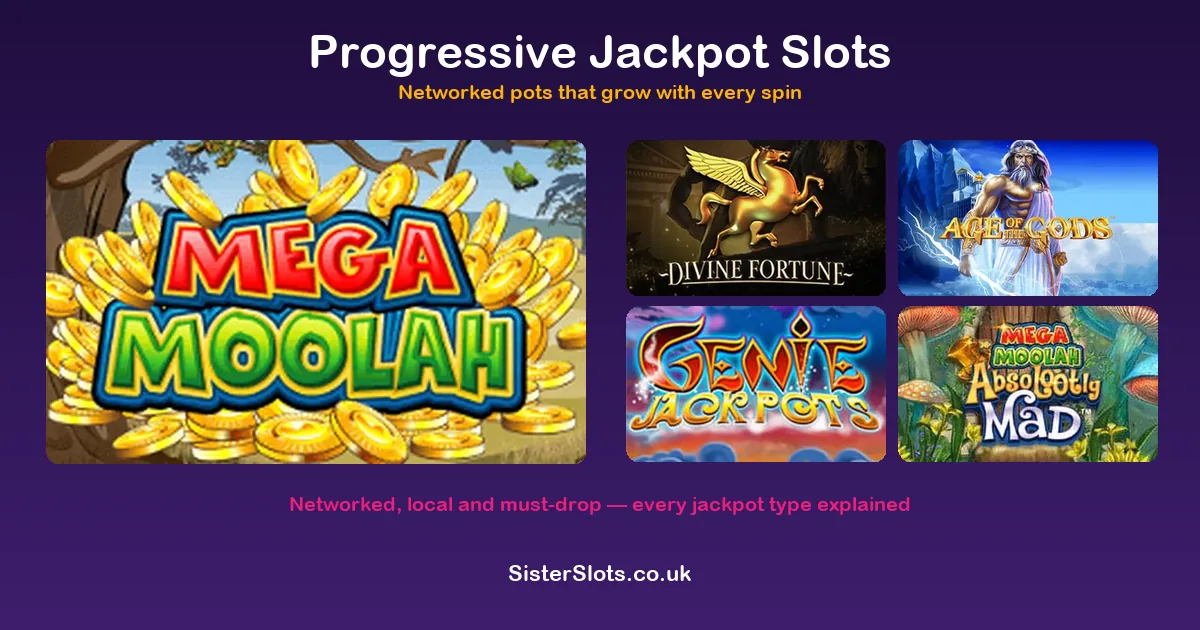
Progressive jackpot slots all make the same promise — a prize that grows until somebody takes it — but they keep it in very different ways. A networked monster like Mega Moolah, a per-casino pot like Divine Fortune and a must-drop daily from Red Tiger are three different products wearing the same word. This guide sorts the jackpot types out properly, then walks through the games that define each one.
Where to Play Progressive Jackpot Slots
Jackpot types: the taxonomy that actually matters
Ignore the marketing names for a moment. Every jackpot slot answers three questions — who feeds the pot, when it has to pay, and how many pots there are — and those three answers are the whole taxonomy.
Networked vs local: who feeds the pot
A networked (or pooled) progressive skims a sliver from every bet placed on the game at every casino that carries it. That is how Mega Moolah’s Mega pot reaches eight figures: thousands of operators, one prize. A local progressive pools only the bets at your own casino — Divine Fortune is the best-known example, which is why its Mega Jackpot shows a different figure at every operator you visit. Networked pots are life-changing and rare; local pots are modest and hit far more often. Neither is “better” — they are different bets.
Fixed vs must-drop: when it has to pay
A classic progressive has no deadline — it climbs until the trigger lands, however long that takes. A must-drop jackpot is guaranteed to pay by a deadline: before midnight, or before the pot reaches a set ceiling. Red Tiger built its Daily Jackpots range on exactly this — the countdown timer turns the jackpot from a lottery into a schedule, and late-evening play around an unclaimed daily pot has become its own little ritual. (A fixed jackpot, by contrast, isn’t progressive at all — a set prize that never grows — and plenty of “jackpot” slots quietly fall in that bucket.)
Tiers: how many pots there are
Almost every modern jackpot game runs several pots at once, usually badged something like Mini, Minor, Major and Mega. The small tiers hit constantly and keep the game feeling alive; the top tier is the headline. Mega Moolah runs four tiers, Playtech’s Age of the Gods series shares four across its whole family, and Relax Gaming’s Dream Drop stretches to five. When a game advertises “jackpots” in the plural, this is what it means.
Every key progressive at a glance
The games below aren’t one family — they’re the landmark implementations of each jackpot type, across six rival studios:
| Game | Studio | Jackpot type | Why it matters |
|---|---|---|---|
| Mega Moolah | Games Global (Microgaming) | Networked, 4 tiers | The record-holding network; jackpot wheel trigger |
| Mega Moolah Absolootly Mad | Games Global | Networked, 4 tiers | The modern face of the same network |
| Mega Fortune | NetEnt | Networked, 3 tiers | Paid a Guinness-record online jackpot in 2013 |
| Hall of Gods | NetEnt | Networked, 3 tiers | NetEnt’s Norse three-tier heavyweight |
| Divine Fortune | NetEnt | Local, 3 tiers | THE per-operator progressive — the contrast case |
| Age of the Gods series | Playtech | Networked, 4 shared tiers | One four-pot network across a whole series |
| Jackpot Giant | Playtech | Networked, single tier | One giant pot, no consolation tiers |
| Wheel of Wishes | Alchemy Gaming / Games Global | Networked (WowPot), 4 tiers | Flagship of the WowPot network |
| Book of Atem WowPot | All41 Studios / Games Global | Networked (WowPot) | Book mechanic meets the jackpot network |
| Genie Jackpots | Blueprint Gaming | Networked (Jackpot King) | Flagship of Blueprint’s Jackpot King system |
| Fishin’ Frenzy Jackpot King | Blueprint Gaming | Networked (Jackpot King) | UK retail royalty wired into the same pot |
| Daily Jackpots range | Red Tiger | Must-drop, timed | The daily deadline pot, across dozens of titles |
| Temple Tumble 2 Dream Drop | Relax Gaming | Networked (Dream Drop), 5 tiers | The five-tier network’s poster game |
| Bonanza Megapays | Big Time Gaming / Relax | Networked (Megapays), 4 tiers | A jackpot bolt-on for the Megaways era |
Checked 10 July 2026. Jackpot values change by the second and (for local pots) by the operator, so we deliberately don’t print them.
The defining games, type by type
Mega Moolah — the networked benchmark
Every conversation about pooled jackpots starts here. The safari slot itself is old, but the four-tier network behind it — entered via a randomly triggered jackpot wheel — has paid the largest online sums in the industry’s history, and newer skins like Absolootly Mad feed the very same pot. Our Mega Moolah family page maps every game wired into the network.
Mega Fortune and Hall of Gods — NetEnt’s pooled pair
NetEnt’s champagne-soaked Mega Fortune produced the win that made mainstream news: a 2013 jackpot recognised as a Guinness World Record for online slot payouts. Hall of Gods runs the same three-tier structure under Norse mythology — you smash shields with Thor’s hammer to find out which pot you’ve won, which remains one of the better jackpot reveals ever built.
Divine Fortune — the local counter-example
Same studio, opposite philosophy. Divine Fortune’s top pot is pooled per operator, so it never reaches Mega Moolah territory — and that’s precisely its appeal. The pot is won often enough that regulars genuinely see it drop, and the base game underneath is strong enough to carry the wait.
Age of the Gods — the series-wide pot
Playtech’s answer was structural: instead of one jackpot game, a whole mythological series — dozens of titles — shares a single four-tier progressive. Whichever Age of the Gods game you spin, you’re feeding and chasing the same four pots. Jackpot Giant, from the same studio, takes the opposite tack: one enormous single-tier pot with no small-tier consolation at all.
Jackpot King — the UK retail crossover
Blueprint’s Jackpot King system bolts a shared pot onto its biggest brands, and its flagship is the Genie Jackpots line, with Fishin’ Frenzy Jackpot King proving the model on the nation’s favourite fishing licence. For UK players this is usually the first pooled jackpot they meet without going looking for one.
Daily Jackpots and Dream Drop — the modern formats
Red Tiger’s Daily Jackpots range made the deadline the product: a pot that must pay before midnight, stamped across dozens of otherwise ordinary slots. Relax Gaming’s Dream Drop network — with Temple Tumble 2 as its poster game — went the other way and stretched the tier ladder to five pots. And Big Time Gaming’s Megapays, carried by Bonanza Megapays, shows where this ends up: jackpot networks as a bolt-on layer for whatever mechanic is fashionable underneath.
Where it all started
The online progressive was born in 1998, when Microgaming launched Cash Splash — the first slot to pool bets from across the young online casino industry into one shared prize. The idea was borrowed from Vegas linked machines, but the internet removed the cable: suddenly the “network” could be every casino running the software. Mega Moolah industrialised the idea, NetEnt glamorised it, and the last decade has been about formats — must-drop deadlines, series-wide pots, five-tier ladders — rather than raw size.
Which progressive jackpot slot fits how you play?
| If you want… | Look at | Because |
|---|---|---|
| The life-changing headline number | Mega Moolah / Wheel of Wishes | The two great networked pools |
| A jackpot you might actually see drop | Divine Fortune | Local pots pay smaller but far more often |
| A deadline instead of a lottery | Red Tiger Daily Jackpots | Must-drop pots are guaranteed to pay on schedule |
| Variety without leaving the pot | Age of the Gods series | Dozens of games, one shared four-tier prize |
| A modern game first, jackpot second | Temple Tumble 2 Dream Drop / Bonanza Megapays | Current mechanics with the network bolted on |
Progressive jackpot FAQs
What is the difference between a networked and a local progressive jackpot?
A networked (pooled) progressive collects contributions from every casino offering the game, so the pot grows fast and can reach eight figures — Mega Moolah is the classic example. A local progressive, like Divine Fortune's, pools only the bets placed at your own operator, so it grows slower and pays smaller — but is typically won more often.
What does “must-drop” mean on a jackpot slot?
A must-drop (or “daily”) jackpot is guaranteed to pay out before a deadline — usually before midnight, or before the pot hits a set ceiling. Red Tiger's Daily Jackpots range built its whole identity on the countdown clock.
Which was the first online progressive jackpot slot?
Microgaming's Cash Splash, launched in 1998 — the first slot to pool bets from players across the young online casino industry into one shared prize.
Do progressive jackpot slots have a lower RTP?
Usually, yes. A slice of every bet feeds the pot, and that slice comes out of the base game's return. You accept slightly weaker session maths in exchange for a ticket to the headline prize.
Can I win a progressive jackpot on a small stake?
On most networked games, yes — any real-money spin can trigger the jackpot round, though several games weight the trigger so bigger stakes get more entries. The published rules for each title spell out exactly how its trigger works.
Sources & Verification
Checked 10 July 2026 against the studios’ own information: Games Global (the Mega Moolah and WowPot networks), NetEnt’s games site (Mega Fortune, Hall of Gods, Divine Fortune), Playtech (Age of the Gods, Jackpot Giant) and Relax Gaming (Dream Drop, Megapays). All named suppliers are UK Gambling Commission-licensed.

Paul edits Sister Slots’ UK slot-family guides. He researches provider histories, mechanics and published game data, checking material claims against provider sources and relevant public records. Unless a page states a dated hands-on method, it reflects documented editorial research rather than real-money play. More about Paul →