
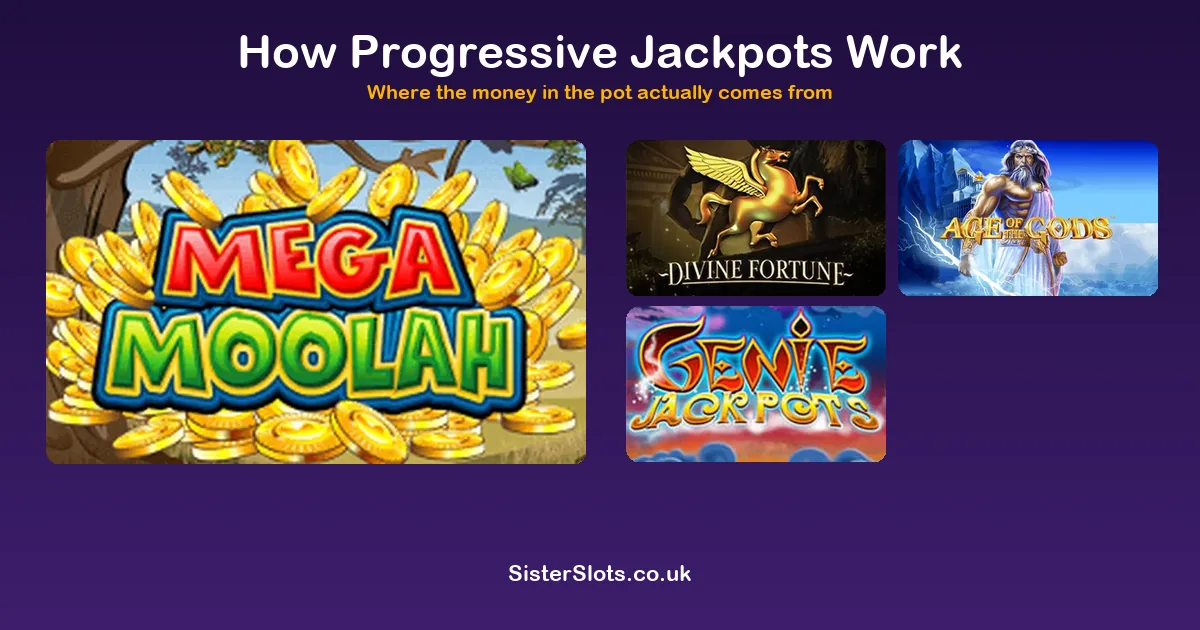
Every progressive jackpot slot makes the same promise: a prize that keeps growing until somebody wins it. How do progressive jackpots work underneath that promise is a different question, and the honest answer is that "progressive jackpot" covers several genuinely different products wearing the same label. This guide is the mechanics behind the number — where the money actually comes from, what a must-drop deadline changes, and what a bonus wheel is really doing when it lands on a spin. For the full list of landmark games across every jackpot type, our Progressive Jackpot Slots guide has the roster; this page is about how the pot itself works.
Where to Play Progressive Jackpot Slots
Where the money in the pot actually comes from
A progressive jackpot isn't funded by the casino, and it isn't sitting there waiting for a lucky spin to "unlock" it. It's built entirely from stakes: every time anyone plays a spin on that game, a small percentage of the bet is skimmed off before the round even resolves and added straight into the pot. Play a networked title like Mega Moolah, and that skim comes from every real-money spin placed on the game at every casino that carries it — not just your own spins. That's the entire mechanism behind the eye-watering headline numbers: thousands of players, at hundreds of operators, all feeding one number at once. The base game's own RTP is quoted after that contribution is removed, which is part of why progressive slots typically return slightly less on the base game than an equivalent non-jackpot title.
Networked vs local: two different pools
The single biggest fork in how progressives work is whether the pot is shared or private. A networked (or pooled) progressive draws contributions from every casino running that game, wiring them all into one central prize — this is how Mega Moolah's top tier reaches eight figures, because it's effectively one prize pool sitting behind thousands of separate casino front-ends. A local (or standalone) progressive only pools the stakes placed at a single operator. Divine Fortune is the standard example: its jackpot shows a different figure at every casino you visit, because each one is running its own private pot rather than sharing a network-wide total.
Neither structure is objectively better — they trade off against each other. A networked pot climbs faster and reaches far bigger numbers because so many more stakes are feeding it, but by the same logic it's won far less often per player. A local pot grows more slowly and tops out smaller, but with a narrower pool of contributing players it also gets won more frequently, so regulars at a given casino stand a realistic chance of actually seeing it drop.
Must-drop and daily jackpots: when the deadline changes the odds
A classic progressive has no deadline. It simply climbs, tier by tier, until a random trigger lands, however long that takes — which could in theory be minutes or months. A must-drop jackpot (also marketed as a "daily" jackpot) works differently: the operator guarantees the pot will pay out before a fixed point, typically before midnight, or once the total reaches a preset ceiling. Red Tiger built an entire product range, its Daily Jackpots line, around exactly this mechanic.
That deadline changes the calculus as it approaches. On a standard progressive, every spin has roughly the same theoretical shot at the trigger regardless of when you play. On a must-drop pot, the jackpot is mathematically guaranteed to land before the cutoff, so the probability of it dropping on any given spin rises the closer the pot gets to its deadline or ceiling without having paid out yet — which is exactly why late-evening play around an unclaimed daily jackpot has become its own little ritual for regular players chasing Red Tiger's range.
Mini, minor, major, mega: why most pots aren't just one number
Almost every modern jackpot game runs several pots simultaneously rather than a single prize. The standard badge set is Mini, Minor, Major and Mega — Mega Moolah runs exactly this four-tier structure, and Playtech's whole Age of the Gods series shares the same four tiers across dozens of titles. Relax Gaming's Dream Drop network stretches the ladder further still, to five tiers. The logic is simple: the small tiers pay out constantly, which keeps the jackpot feature feeling alive and relevant on every session, while the headline tier is the rare, life-changing one that gets the marketing. When a provider advertises "jackpots" in the plural on a single game, this tiered structure is almost always what it's describing.
What actually triggers a jackpot round
Jackpot triggers are random, not guessable, and not tied to any visible pattern in the base game. The most common mechanism across networked progressives is a randomly awarded bonus round — typically a wheel, as on Mega Moolah, or an in-game random event tied to specific symbol combinations, as with Blueprint's Jackpot King system, which underpins Genie Jackpots and Fishin’ Frenzy Jackpot King. Landing the trigger drops you into a separate bonus game — a wheel spin, a pick-me screen, or similar — that determines which of the available tiers you've actually won. None of this is influenced by anything the player does beyond placing a qualifying real-money spin; the published rules for each individual game spell out exactly how its own trigger and tier-selection mechanic works, and they're worth reading before you play a jackpot title for the first time.
Does a bigger stake mean better jackpot odds?
It depends on the network, and providers aren't always consistent with each other on this point. Blueprint Gaming's Jackpot King system explicitly states that bet size doesn't affect your chances of triggering the jackpot round at all — any qualifying real-money spin, including the minimum stake, has an equal shot, and there have been genuine winners playing at the lowest available bet level. Other networks scale the odds with stake size instead, weighting bigger bets toward more frequent bonus-round entries while still leaving the jackpot technically reachable from the minimum bet. Because the two approaches genuinely differ by provider, the only reliable way to know how a specific game's trigger works is to check that title's own published rules rather than assume one system's approach applies everywhere.
Progressive jackpot mechanics FAQs
Does my stake affect my progressive jackpot chances?
On some networks, no — Blueprint's Jackpot King gives every real-money spin an equal shot regardless of bet size. On others, bigger stakes are weighted toward more frequent jackpot-round entries. It varies by provider, so check the specific game's published rules.
What's the difference between a networked and a local jackpot?
A networked (pooled) jackpot collects a slice of every stake placed on that game at every casino carrying it, so it grows fast and can reach eight figures. A local jackpot only pools the stakes placed at a single operator, so it grows slower and pays smaller — but tends to be won more often.
Why do must-drop jackpots have a countdown?
Because the operator guarantees that pot will pay out before a set deadline or ceiling, rather than letting it climb indefinitely. As the deadline approaches without a win, the mathematical chance of it dropping on any given spin rises, which is why must-drop pots draw a rush of play late in their countdown window.
Sources & Verification
Checked 10 July 2026 against the studios’ own published information: Games Global (Mega Moolah, WowPot), NetEnt’s games site (Divine Fortune), Playtech (Age of the Gods) and Relax Gaming (Dream Drop). For the full landmark-game roster across every jackpot type, see our companion Progressive Jackpot Slots guide. All named suppliers are UK Gambling Commission-licensed.

Paul edits Sister Slots’ UK slot-family guides. He researches provider histories, mechanics and published game data, checking material claims against provider sources and relevant public records. Unless a page states a dated hands-on method, it reflects documented editorial research rather than real-money play. More about Paul →